Issues
Where Scott stands
Everything below comes out of work already on the public Council record.
1. Water Quality and Infrastructure Accountability
St. Helena has plenty of water. The problem is what happens between the treatment plant and the tap. Water leaves the Bell Canyon plant meeting state standards, but manganese deposits that have built up in aging pipes over decades get stirred up on the way to your house, which is why parts of town still get brown water, and many residents rely on filters or bottled water.
Scott raised the manganese problem directly with the City Manager's office and stayed on it until a mitigation plan landed on the Council agenda. Water quality is now a regular item at Council meetings, which gives the Council and residents a regular look at progress and a way to reset priorities inside the water enterprise. That kind of follow-through, working an issue with staff between meetings instead of waiting for it to show up on its own, is a big part of how Scott approaches the job.
When the Napa County Civil Grand Jury issued its report on the city's water system, Scott read the city's draft response closely and flagged several accuracy and citation problems. One example was a "75% reduction in taste and odor complaints" figure that appeared three times without a source. The Council directed staff to make the corrections. His view is simple: residents should be able to verify what the city tells them about their water, not just take it on faith.
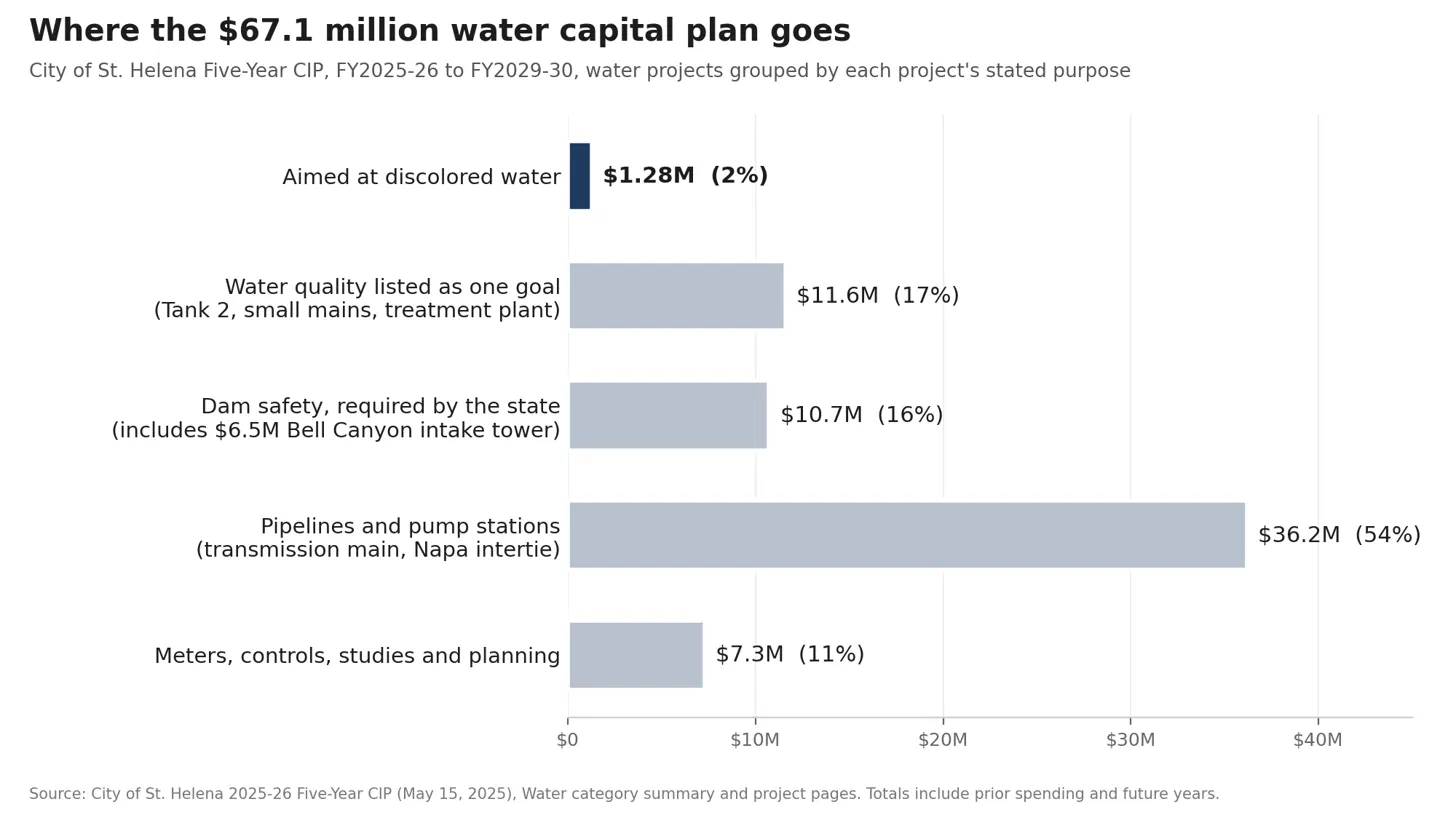
Scott has also spent time learning the Water and Wastewater Department's operations and the major investments that keep the system running, like the Bell Canyon intake tower replacement. He has said on the record that even though it's expensive, the water enterprise may need to shift its own capital dollars toward water quality. Of the $67.1 million in water projects in the City's 2025-26 five-year capital plan, only one, at $1.28 million, was aimed specifically at discolored water. Another $11.6 million in projects lists water quality as one of several goals. The largest Bell Canyon project, the $6.5 million intake tower, is a dam-safety upgrade required by the state. Good water policy starts with good data, and Scott insists the city have it before it speaks publicly.
2. Fiscal Sustainability and Budget Oversight
Scott is the only person on the dais with an accounting degree and a career built on reading a P&L. He's used that background to go line by line through years of the city's audited General Fund data, tracing disputed numbers back to their source rather than relying on summaries.
For Scott's position on Measure S, see Measure S: Two Separate Questions below.
Measure S: Two Separate Questions
When I talk with residents about Measure S, I hear two different concerns. I think they deserve separate answers.
Does the city need the revenue?
I didn't take anyone's word for it. I went through the city's audited financial statements myself, and here's what they show.
Our reserves are strong today. The General Fund's unassigned balance grew from about $2.3 million in 2015 to $15.2 million in 2025, roughly 73% of a year's spending. That's well above the city's 30% target, and it reflects years of careful budgeting.
Some of that growth was one-time money. About $3 million came from outside sources in 2021 and 2022, including pandemic relief, disaster reimbursements and insurance payments. That money won't repeat. Without it, the reserve would be closer to 58% of a year's spending.
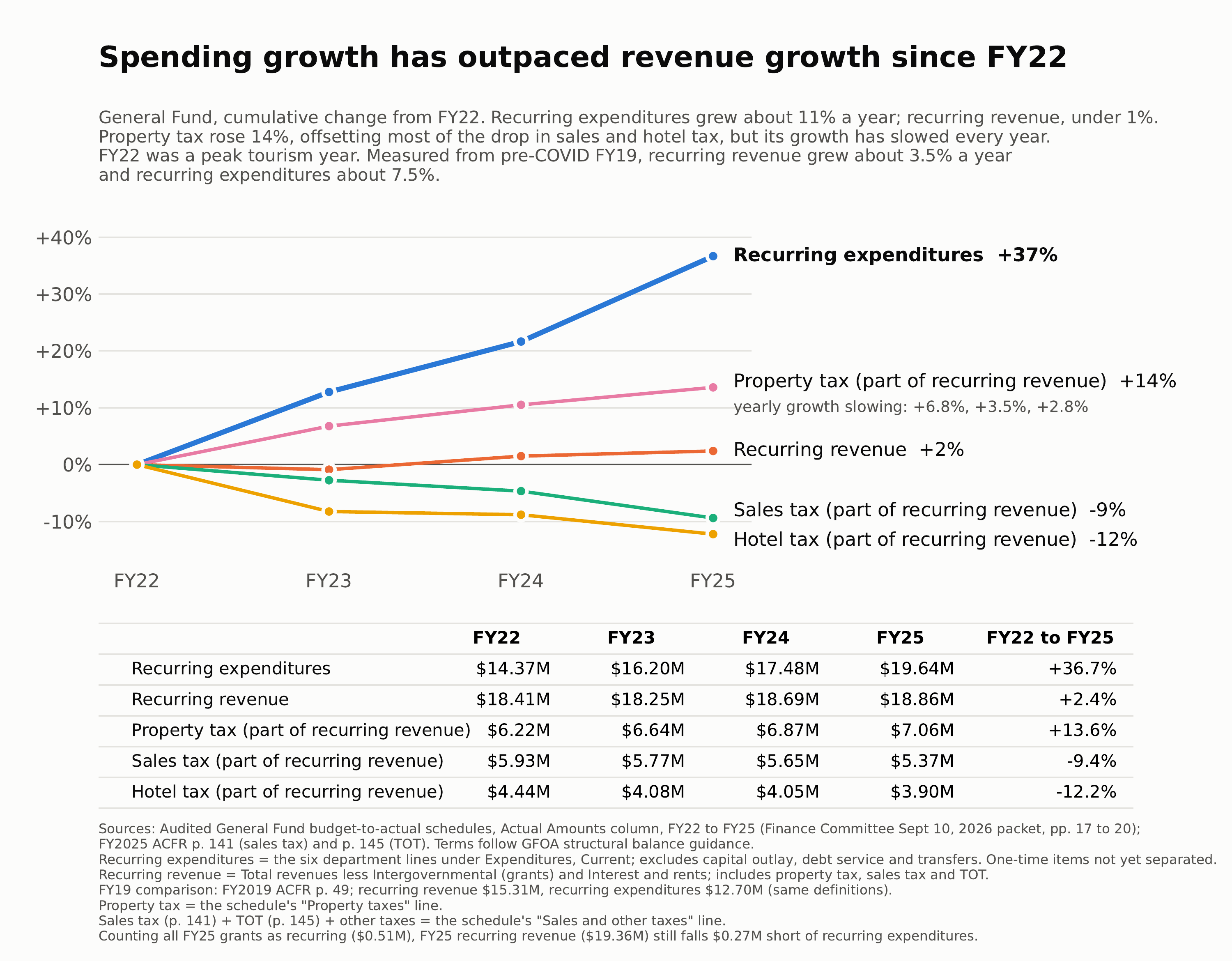
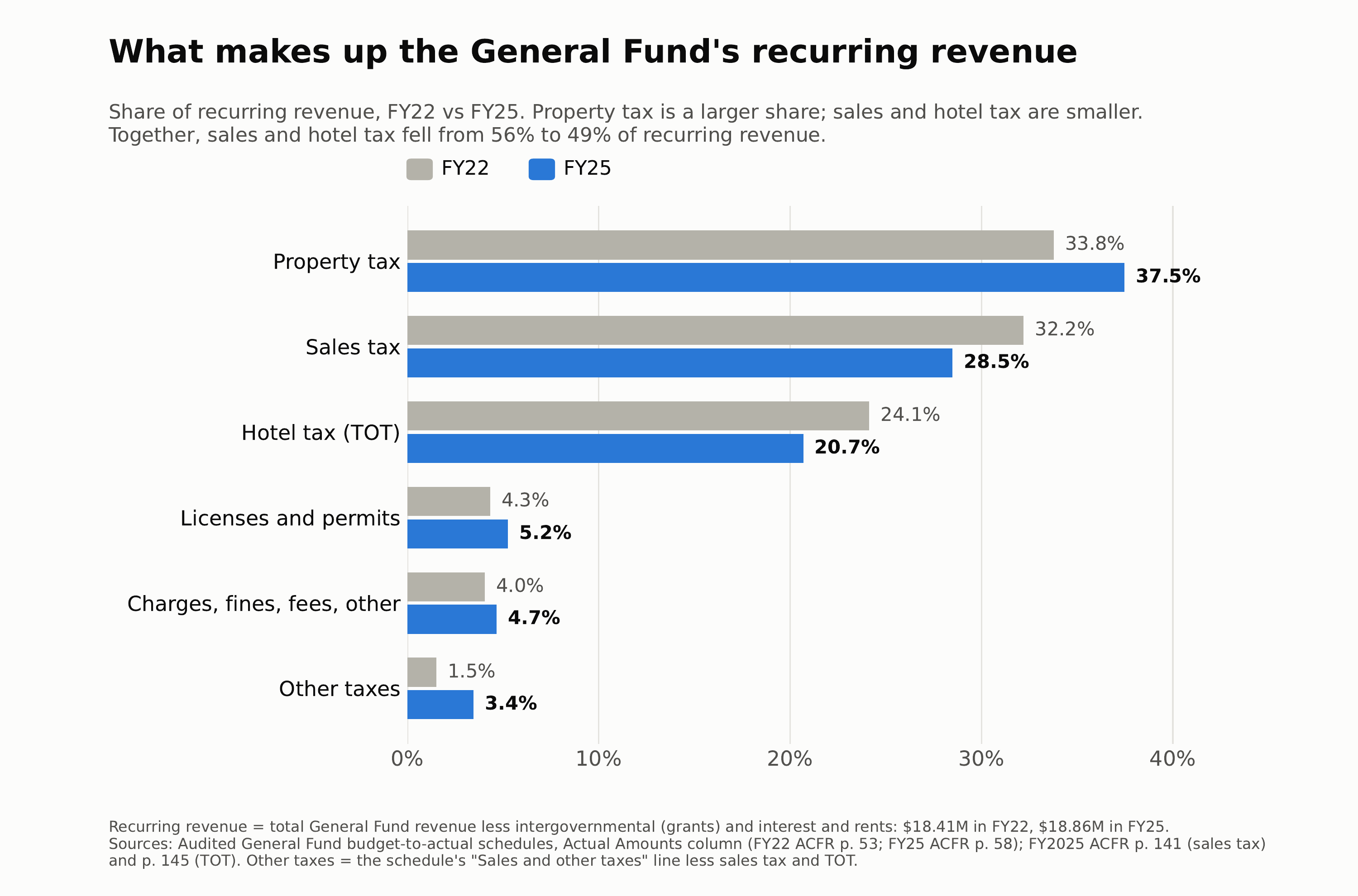
The bigger issue is the trend since 2022. Using the city's audited figures, the General Fund's recurring costs have grown about 11% a year, while its recurring revenue has grown less than 1% a year. Sales tax revenue is down about 9% and hotel tax about 12% from their 2022 peak, though both are still above 2019 levels. Property tax, the City's largest source of revenue, grew 14% over the same period, but its growth has slowed every year. Under Proposition 13, most properties can rise only 2% a year in assessed value unless they sell, and with mortgage rates above 7%, fewer homes are selling. In 2025, recurring revenue didn't cover recurring costs, the first time that has happened outside the pandemic in at least ten years.
Why focus on the years since 2022? A long average blends together three very different periods: steady growth before the pandemic, the COVID years, and the years since. I want to know what it costs to run the City today, and the recent years answer that best. Visitor patterns and costs have changed since 2020, and so has our core industry, wine. To be fair, 2022 was a peak year for tourism, so I also compare against 2019, before COVID. Measured from there, recurring revenue grew about 3.5% a year and recurring costs about 7.5%. The gap is smaller, but it runs the same direction.
Swipe sideways to see the whole chart
Swipe sideways to see the whole chart
After transfers, the General Fund ran deficits of about $1.1 million in 2023 and about $1 million in 2025. The city's forecast, presented to the Council on July 7, shows reserves declining over the next several years if nothing changes. To be fair, past city budgets have tended to predict worse results than actually happened, so I don't take any forecast on faith. But I'd rather address a gap while reserves are strong than wait until they're gone.
Measure S would add half a cent to the sales tax, or 50 cents on a $100 purchase. Groceries, prescriptions and labor aren't taxed. And the City's sales tax consultant estimates that about 80% of St. Helena's sales tax is paid by people and businesses from outside St. Helena.
St. Helena already has one local half-cent sales tax. Voters approved Measure D in 2016, and it brings in about $2 million a year with no sunset date. Measure S would add a second half cent.
Measure S at a glance
- Adds one-half cent to the local sales tax: 50 cents on a $100 taxable purchase
- Groceries, prescription medications and labor like installation and repairs are not taxed and would not be affected
- An estimated 4 out of 5 sales tax dollars in St. Helena are paid by people and businesses from outside St. Helena (City sales tax consultant estimate)
Where does the 80% come from?
It's an estimate, not a count. Sales tax records don't show who made a purchase, so the City's sales tax consultant estimated it from the kinds of businesses in town, local demographics and state sourcing rules, using 2025 data for the City's existing 1% sales tax.
You can check the resident share yourself using Measure D, our existing half cent, which works the same way Measure S would:
- Measure D brings in about $2 million a year (City operating budget).
- At half a cent per dollar, that's about $400 million in taxable purchases ($2 million ÷ 0.005), including online purchases delivered to homes in town.
- If residents paid 20% of that, it would be $80 million.
- Spread across about 5,200 residents, that's roughly $15,000 per person, or about $60,000 a year for a family of four.
Two caveats. The estimate counts businesses and contractors from outside St. Helena, not just visitors. Measure S, like Measure D, is based on where an item is delivered. Wine shipped out of town isn't subject to it, but online purchases delivered to homes in town are, so the share paid by non-residents is likely somewhat lower than 80%. Either way, most of it is paid by visitors and businesses from outside St. Helena.
Sources: City of St. Helena audited financial statements, FY2015 to FY2025; FY2025 Annual Comprehensive Financial Report, statistical section (sales tax and hotel tax); July 7, 2026 City Council presentation; City of St. Helena Measure S FAQ.
Can we trust the city to spend it well?
This is the harder question, and I understand why people ask it. St. Helena has had a lot of turnover at City Hall, and residents have watched important projects slip. That concern is fair.
But it's a different question from the first one. Voting no doesn't fix it. What fixes it is a Council that reads the numbers, asks where every dollar goes, and makes the answers public.
That's how I've approached this job since May. I reviewed the audits line by line before I voted to put Measure S on the ballot. I flagged unsupported numbers in the city's draft Grand Jury response, and the Council directed staff to correct them. If Measure S passes, I'll push for a clear public report every year showing what it brought in and where the money went.
Some of those safeguards are already written in. Measure S requires independent audits and public disclosure of how the money is spent. The Interim Strategic Plan the Council accepted in August also calls for a Finance Department led by a CPA and an audit for fraud, waste and abuse.
So I'd ask you this: if you're leaning no, is it because you don't think the city needs the revenue, or because you don't trust how it will be spent? If it's the second, I'm asking for your vote so I can keep working on exactly that.
For the city's official information, see the Measure S FAQ and the Impartial Analysis.
For an outside view, the St. Helena Star's editorial board weighed the measure on October 13. Read the editorial
3. City Government Efficiency
In 2025 the city commissioned an outside efficiency and business transformation study. Studies like that often sit on a shelf. Scott was part of the City Council that turned the study's findings into a citywide Interim Strategic Plan covering fiscal sustainability, technology and department priorities. The Council accepted it in August 2026.
Scott holds certifications in AI Fluency (Anthropic) and Microsoft Power Platform Fundamentals (PL-900).